
What can teachers claim on tax in Australia?
Teaching aids, professional learning related to your current duties and eligible working-from-home costs are useful places to start reviewing your spending. The challenge is often explaining which purchases were for class, which were personal, and what the school paid back.
General information for Australian employee teachers and education professionals. ATO sources checked 6 September 2026. Check your circumstances with a registered tax agent where needed.
Common teaching expenses to review
- Teaching aids: materials used in lessons, relevant books, stationery and achievement prizes may qualify. They must serve your teaching duties, and mixed use needs apportionment. ATO: teaching aids and equipment.
- Professional learning: a course needs a sufficient connection to your current work. Training to enter a new occupation is a different case; HECS-HELP fees and loan repayments are not deductible. ATO: self-education expenses.
- Preparation at home: additional running costs for lesson planning or marking can qualify when you satisfy the method’s conditions and keep its records. Equipment your employer provides is not your purchase to deduct. ATO: working from home.
You must have paid the expense yourself without reimbursement and keep supporting evidence. Everyday clothing remains private even when worn for teaching; the exceptions for eligible uniforms or protective clothing have specific conditions. ATO: clothing and other expenses.
A category and tag setup for a teacher
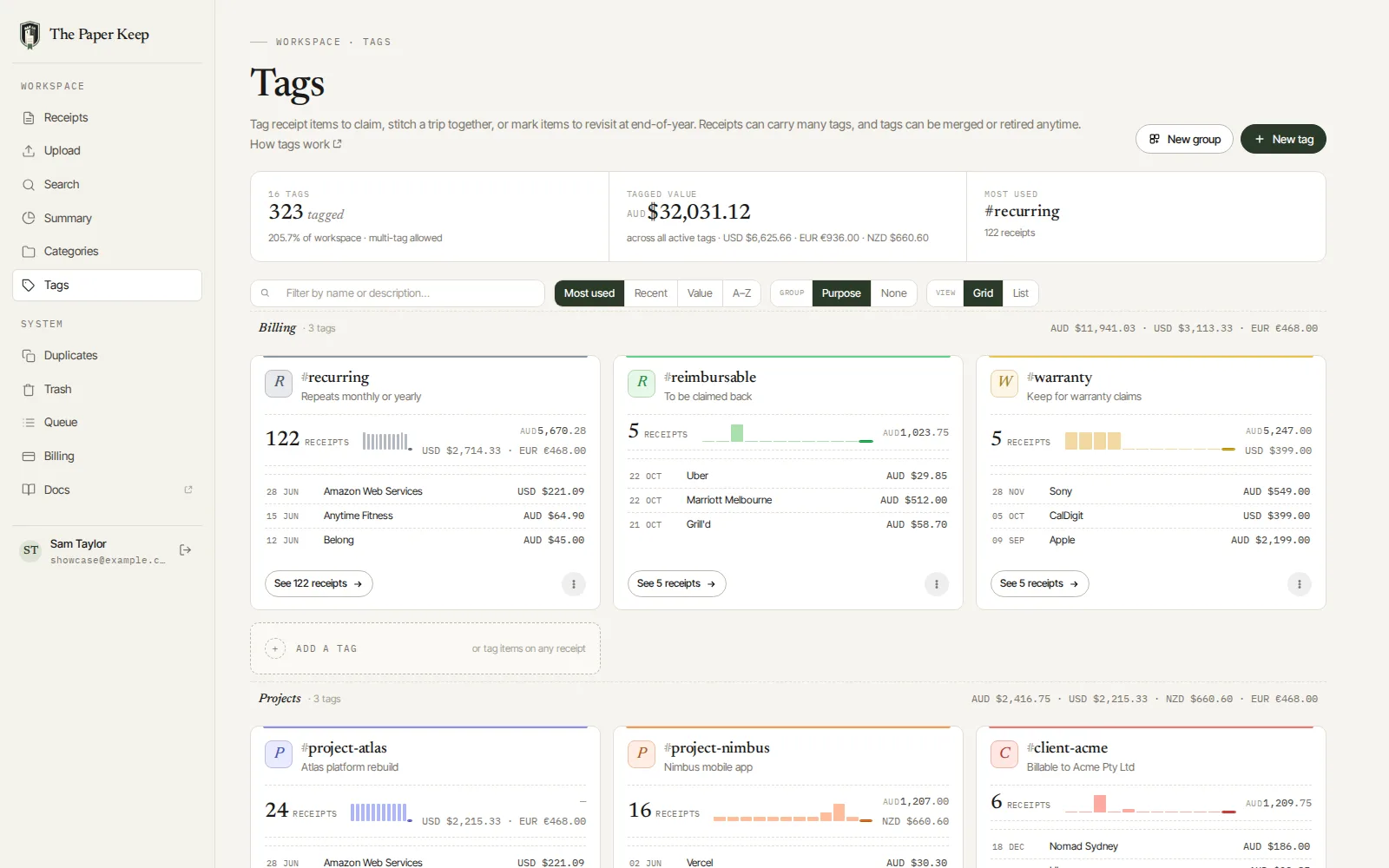
Create these as your own categories in The Paper Keep, leaving the Tax deductible flag off on review categories until you resolve their treatment. Use the tags on individual line items, then add receipt notes to explain the class, activity or work-use calculation.
| Category to create | Item tags to try | Note to keep |
|---|---|---|
| Teaching materials | classroom, science, work-use-review | Which lesson or class used the item; any personal use. |
| Professional learning | cpd, literacy | How the course relates to your current teaching duties. |
| Equipment for review | laptop, depreciation-review | Purchase date, work share and reimbursement status. |
| Home office bills | wfh, marking | Keep the separate hours and usage records that support an estimate. |
AI can suggest categories during parsing; a good category description helps it distinguish classroom materials from household shopping. Review the suggestion, especially for a retailer that sells both. See categories and item tags for the controls.
Example: one shop, two purposes
Illustrative record-keeping example: a $75 receipt contains $45 of classroom supplies and $30 of household goods. Upload the full original, tag only the relevant supply items classroom, and note what the class used them for. Keep the whole receipt in a review category until you resolve its tax treatment.
The tags help you find the $45 of items. They do not turn the receipt’s $75 total into a $45 deduction. The summary’s category-based deductible figure uses whole receipts, so simply marking the receipt category deductible would include the personal goods too. Keep the adjustment in your review working papers; do not rewrite the original total.
Use the WFH estimator for planning and marking
If you do eligible work at home, map relevant AUD bill categories in the WFH estimator, review which receipts feed each expense kind, and enter your hours pattern and supported work-use percentages. You can record work assets separately. The screen compares fixed-rate and actual-cost estimates.
Keep a diary of actual marking and preparation hours outside the app: a modelled weekly pattern is not that evidence. Do not add phone or internet again when using the fixed rate. For future-year planning, check that year’s published rate before relying on the result. ATO: fixed-rate records and included costs.
Build next tax time’s evidence term by term
After a materials shop, photograph the receipt and tag the class items. Forward your next course receipt and note its purpose. At the end of term, check which expenses the school reimbursed. A reimbursed tag is a reminder to review the amount; it does not automatically exclude it.
Use the tax-year summary and CSV export to prepare your records. Review mixed purchases, work shares and equipment treatment before settling a claim. The result is an organised set of evidence, not a guaranteed refund.
See another role in our Australian occupation tax guides.
Make next tax time easier.
Keep your originals, organise expenses with categories and item tags, and review the year in one place. Use the WFH estimator when it applies, then export your receipt records for tax-time review.
Start a 14-day free trial. No credit card required.
When you're ready to do this in The Paper Keep, these are the click-by-click pages.