
What can nurses and midwives claim on tax in Australia?
For nurses and midwives, useful expenses to review include equipment you buy for your duties, eligible protective clothing, union fees and education connected to your current role. Keep a clear distinction between what your work requires and what you personally paid without reimbursement.
General information for Australian employee nurses and midwives. ATO sources checked 6 September 2026. This is not a guide to running a private practice.
Common nursing expenses and their conditions
- Equipment: a stethoscope or other tool used in your duties may qualify for its work-use share. The cost may need to be claimed over time; an immediate deduction has conditions, including rules about sets and similar items. ATO: tools and equipment.
- Protective clothing and eligible uniforms: the protective qualities or uniform rules matter. Ordinary white shirts and black trousers are not deductible just because you wear them at a hospital. ATO: clothing and uniforms.
- CPD and professional fees: education needs a connection to your current duties. Union and professional association fees can qualify; retain the invoice or appropriate income-statement evidence. ATO: self-education; ATO: professional association fees.
Shift work does not make every shift cost deductible
Normal travel between home and a regular workplace remains private, including early starts and night shifts. Travel directly between separate jobs can be different. Record the actual journey and purpose instead of labelling every fuel receipt as work travel. ATO: car expenses.
Ordinary meals and snacks at work are private. Overtime meals have specific allowance and other conditions; a long shift alone does not establish a deduction. Prescription glasses and vaccinations are also private costs under the nursing guidance. ATO: meal and glasses expenses; ATO: vaccinations.
Organise a nurse’s receipts in The Paper Keep
| Category to create | Item tags to try | Note to keep |
|---|---|---|
| Clinical equipment | stethoscope, work-use-review | Which role uses it, private use, and whether the employer paid anything. |
| Professional learning | cpd, clinical-skills | Course topic and its connection to your present duties. |
| Professional fees | union, membership | Membership period and whether the amount also appears on an income statement. |
| Work clothing for review | uniform, protective | Why it meets the uniform or protective-clothing conditions. |
Give categories clear descriptions so parsing suggestions have useful context. Review the extracted line items, then add your tags using each item’s row. A receipt note can capture the purpose while it is fresh. Leave the Tax deductible flag off on review categories while eligibility or reimbursements are unresolved. Categories group the spending; tags help you return to a particular type of item or review question.
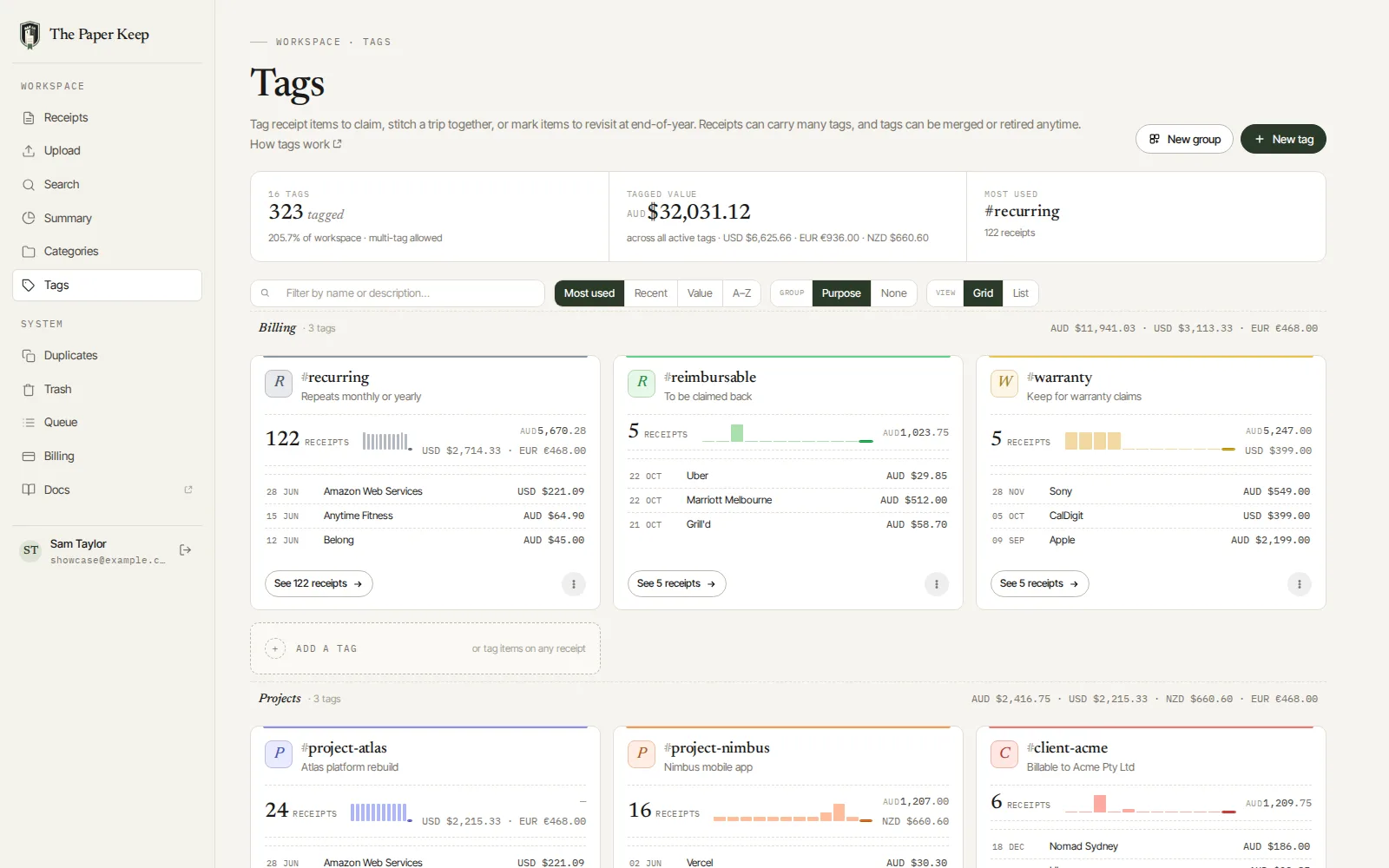
Example: a course and a reimbursed purchase
Illustrative workflow: you pay $240 for a course connected to your current clinical duties, then receive $100 back from your employer. Save the $240 receipt and note the reimbursement date and amount. Tag its item cpd and reimbursement-review.
Your unreimbursed cost is $140, subject to the course’s tax eligibility. The Paper Keep still preserves the $240 receipt total; the tag does not subtract $100 from the summary. Keep it in a review category and reconcile the reimbursement when preparing your claim. That makes the history understandable without altering the source document.
What the summary and estimates help with
The tax-year summary groups your saved receipts by category and can show tag totals. Export the year to CSV, with receipt notes included, to review with your tax agent. The export has one row per receipt, so check the underlying items for mixed purchases.
The WFH tool is relevant only if you also have eligible work at home. It is not a nursing-shift, vehicle or overall tax-refund calculator. For a hospital-based role, receipt capture, classification and a clear reimbursement record are likely to be the more useful starting points.
A small routine for the coming year
Forward a course receipt when you enrol, photograph equipment purchases, and save the work-purpose note. Once a month, review reimbursement and membership records so the same payment is not counted twice. Keep separate journey or usage records where needed. See the occupation guide overview for the full preparation workflow.
Make next tax time easier.
Keep your originals, organise expenses with categories and item tags, and review the year in one place. Use the WFH estimator when it applies, then export your receipt records for tax-time review.
Start a 14-day free trial. No credit card required.
When you're ready to do this in The Paper Keep, these are the click-by-click pages.