
What can construction workers claim on tax in Australia?
Tools, protective gear and work-related licence renewals are common starting points for a construction employee’s tax review. Large equipment purchases, private use and travel to a work site need extra care. This guide covers employees, including employed tradespeople; sole-trader business rules are different.
General Australian tax information. ATO sources checked 6 September 2026. For business purchases, use the sole-trader guide and advice appropriate to your business.
Expenses to review
- Tools and repairs: tools you buy for your duties can qualify for their work-use share. Employer-provided tools are not your expense. A larger purchase may require decline-in-value deductions, and sets or similar items can affect immediate-deduction eligibility. ATO: tools and equipment.
- Protective clothing: protection against a specific work risk matters. Everyday jeans and drill shirts are not automatically protective workwear. ATO: clothing and uniforms.
- Licences and cards: renewing a licence needed for current duties can qualify. Getting an initial qualification or licence to obtain a job is a different situation. ATO: licences, permits and cards.
- Training: check how it connects to the work you already do and whether the employer reimbursed it. ATO: self-education.
Do not treat every trip to a site as work travel
Normal home-to-work travel is generally private. The bulky-tools exception needs essential, genuinely bulky equipment that is awkward to transport, a vehicle needed for convenient transport, and no secure workplace storage. Taking tools home by choice is not enough. Keep the journey details and check the rule that applies to your situation. ATO: car expenses and bulky equipment.
A practical setup for tools and site purchases
| Category to create | Item tags to try | Note to keep |
|---|---|---|
| Tools and equipment for review | power-tools, depreciation-review | Work-use share, purchase date, whether it forms a set, and any employer payment. |
| Protective gear | ppe, boots | The work hazard the item protects against. |
| Licences and training | renewal, current-role | Whether it renews an existing work requirement or qualifies you for a new job. |
| Travel for review | site-transfer, journey-record | Start and end locations, work purpose, and the separate journey record. |
Create these suggested categories yourself; leave the Tax deductible flag off on review categories while their treatment is unresolved. The Paper Keep can suggest categories as receipts are parsed. Add tags to the relevant line items, then review what the supplier actually sold: a hardware shop can supply both your work tools and a home renovation.
Example: a hardware receipt with private purchases
Illustrative workflow: a $430 receipt includes a $360 drill for work and $70 of garden supplies. Keep the full receipt. Tag the drill power-tools and depreciation-review; label the garden items personal. Add a note explaining the drill’s work use.
The drill’s price and any work share need a depreciation review rather than treating the whole $430 as an immediate claim. Item tags make that review easier; they do not change the receipt-based deductible total. Avoid marking the whole receipt deductible while personal items or asset treatment are unresolved.
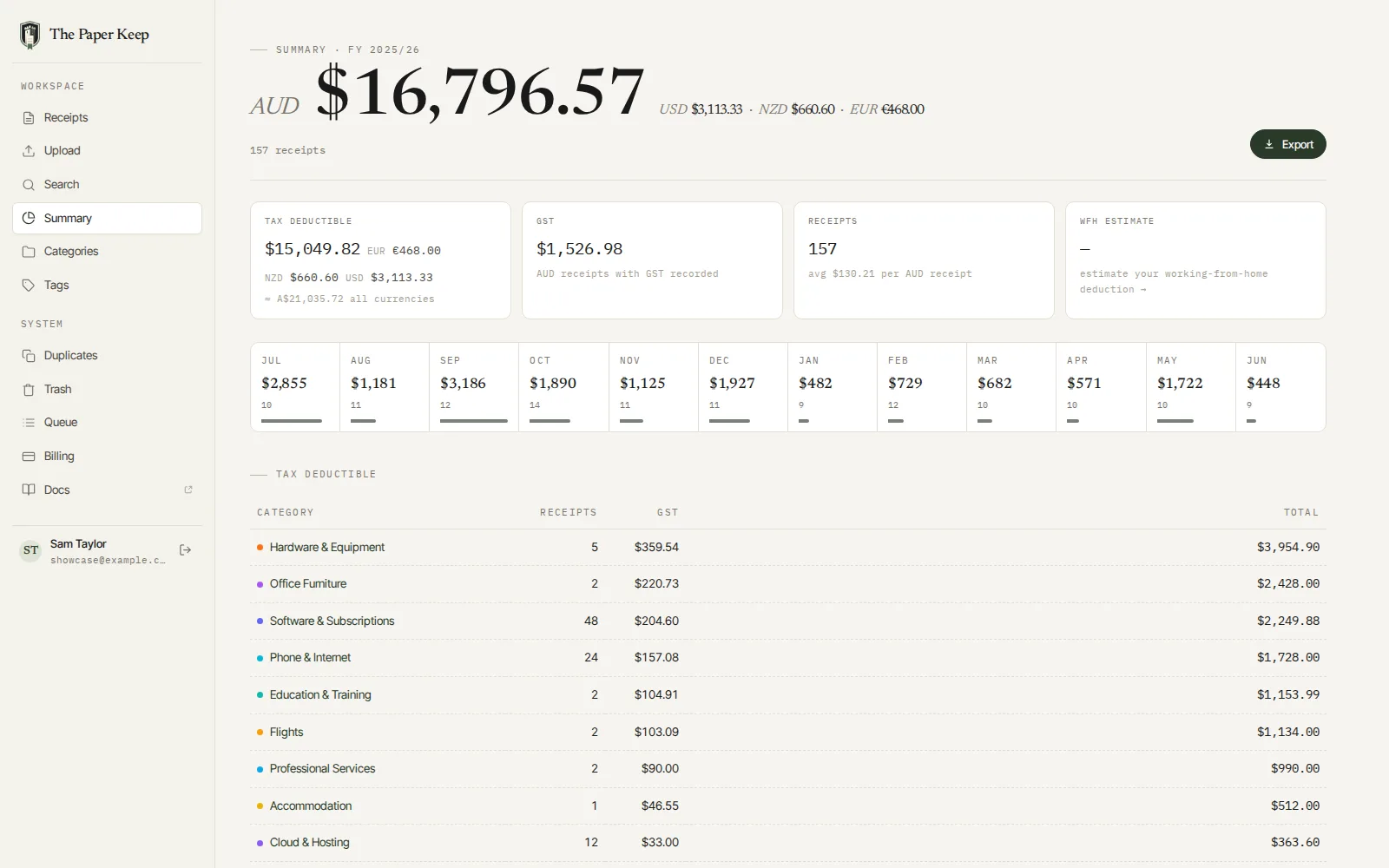
Turn organised receipts into reviewable figures
Use the tax-year summary to see spending by category and inspect the receipts behind a total. Its CSV includes categories, item-tag names and notes, one row per receipt. Keep the separate calculation for depreciation, reimbursements and private use with your tax working papers.
The Paper Keep’s WFH estimator is designed for home-working bills and assets. It is not a complete construction-tool depreciation schedule or a vehicle logbook. For those calculations, use the relevant ATO tool or your tax agent and keep the purchase evidence here.
Start while the job is still fresh
Photograph a till receipt before it fades. Add a brief note identifying the job or work purpose; use item tags if you want to revisit costs across a project. Check reimbursements each month and keep travel records as journeys happen. At tax time you can review the exceptions instead of rebuilding a year of hardware purchases from bank statements.
See another role in our Australian occupation tax guides.
Make next tax time easier.
Keep your originals, organise expenses with categories and item tags, and review the year in one place. Use the WFH estimator when it applies, then export your receipt records for tax-time review.
Start a 14-day free trial. No credit card required.
When you're ready to do this in The Paper Keep, these are the click-by-click pages.