
Can I claim electricity when working from home?
Yes, eligible additional electricity or gas costs from working at home can qualify. You need to incur the expense yourself, exclude private use and follow the records required by your chosen method. Being at home during the day does not make the entire household bill deductible. ATO: WFH expenses.
General information for Australian employees. Official sources checked 6 September 2026. Check the rules for your claim year and ask a registered tax agent where your circumstances need individual advice.
Fixed rate or actual energy costs?
The WFH fixed rate already includes energy for heating, cooling and lighting, along with other covered running costs. You cannot add a separate electricity amount on top. Keep actual work-from-home hours across the year and evidence of the covered expenses you incur. ATO: included expenses and records.
For actual costs, the ATO describes a calculation using your tariff, the equipment’s power consumption and work-use hours. Account for private and shared use. A whole-bill percentage needs a reasonable basis; the proportion of days you work at home is not automatically that basis. ATO: energy calculations.
Example: one appliance’s work use
Illustrative calculation: a 0.6 kW appliance used for 200 eligible work hours at $0.30 per kWh costs 0.6 × 200 × $0.30 = $36. This only models that appliance under those assumptions. It does not establish the deductible share of every charge on your bill or account for other household members using the same heating.
Keep the bill showing the tariff, the appliance information and the work-hours evidence. If tariffs or usage change during the year, account for that instead of multiplying a convenient month by twelve.
How to organise the bills in The Paper Keep
- Collect electricity and gas receipts by forwarding emails, connecting a supported inbox or uploading the original bill.
- Use an Energy bills category and tag relevant line items
wfh-energy. Add a note explaining where the work-use calculation is kept. - In the WFH estimator, map the category to Electricity & gas. Review individual bills and exclude costs that should not feed the model.
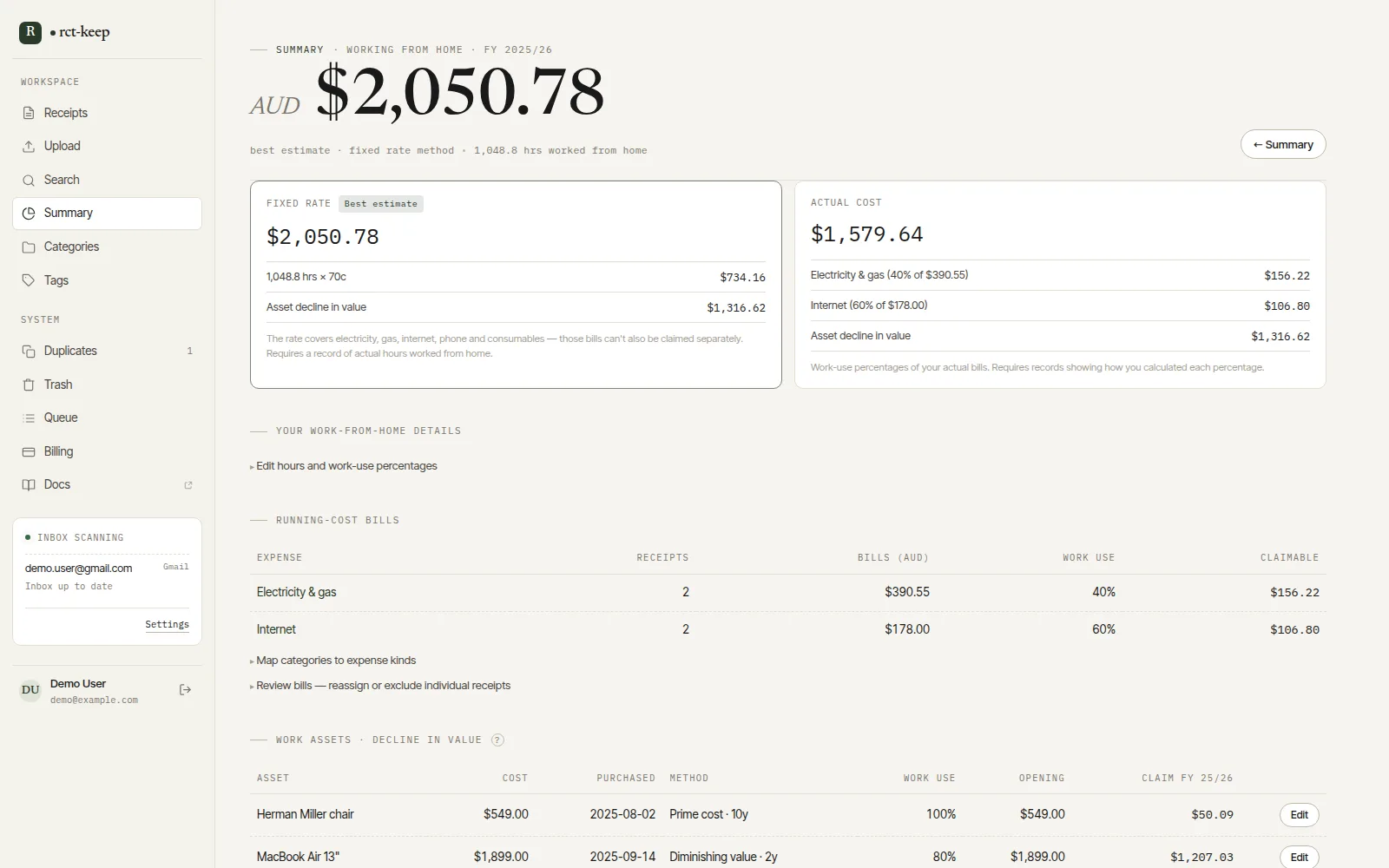
The actual-cost model multiplies mapped AUD bill totals by your entered percentage. It does not perform the appliance calculation above. If your supporting calculation does not fit that bill-share model, keep it separately rather than changing a percentage merely to get a larger result.
Before you use the estimate
Do not add the energy-category total to the WFH result: that can count the same spending twice. The receipt summary keeps original amounts; tags and notes do not subtract private use.
The screenshot uses FY 2025/26. For later years, verify the published fixed rate before relying on a projection. See the internet guide for another bill covered by the same fixed rate.
Compare another item in our WFH expense guides.
Make next tax time easier.
Keep your originals, organise expenses with categories and item tags, and review the year in one place. Use the WFH estimator when it applies, then export your receipt records for tax-time review.
Start a 14-day free trial. No credit card required.
When you're ready to do this in The Paper Keep, these are the click-by-click pages.